
The rhythm
A kick-off, twelve weeks, a wrap-up.
week 0
Kick-off
Week 1-12
Every week
Monday
Mon-Fri
Practise it in meetings and one-on-ones that are already in the diary.
Wednesday
A one-line question in the cohort’s private channel.
Friday
One question on the playcard to end the week. Managers answer it for themselves; nothing is collected.
Week 12
Wrap-up
A 60-minute online session to look at what changed and pick the habits worth keeping.
Managers re-take the Scorecard and look back at where they started. HR gets the anonymised cohort report.
Three levels, every week
Every manager picks their own stretch.
The same challenge works for a new team lead and a senior manager, because each one chooses how far to take it.
Here’s Week 1, Watch Yourself Work.
Level 1
Starter
The minimum rep for a busy week. Anyone can do it.
Keep a leadership journal: one sentence a day about a moment you showed up as a leader.
Level 2
Stretch
The default. Most managers pick this one.
Add a second sentence to each entry: what the moment produced. What did the other person do next?
Level 3
Brave
Not for the comfortable. Senior leaders find it hard too.
Share the pattern that surprised you most with a trusted peer and ask: “Is this how you see me?” Accept the answer.
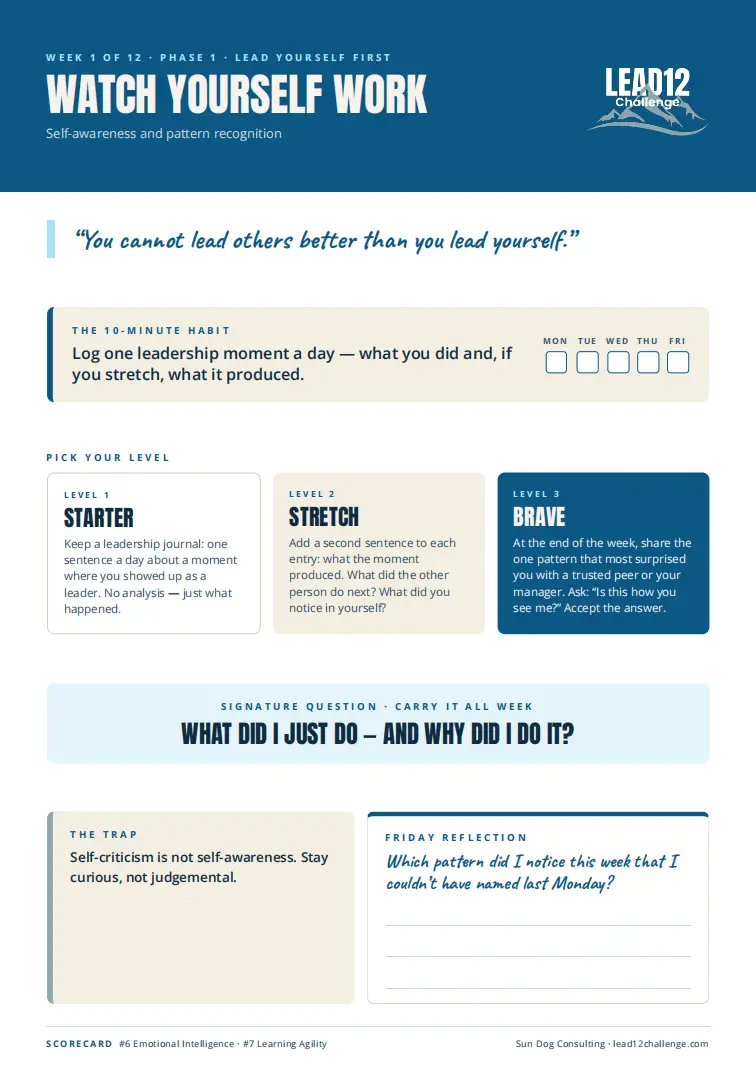
The playcard
Every week fits on one page.
Print it, pin it, or keep it on your phone. Each playcard has:
- the ten-minute habit for the week
- the challenge at three levels
- a signature question to carry all week
- the trap most managers fall into
- a Friday reflection prompt
The Monday video explains the brain science behind the habit, in plain language. That’s the “why” that makes the “what” stick.
The 12 weeks · Four phases · One progression
Twelve challenges. Each one closes a specific gap.
Every week tackles one behaviour most managers know they should do, and don’t. Each phase needs the one before it.
Phase 1 · Week 1-3
Lead yourself first
You can’t lead others better than you lead yourself.
Log one leadership moment a day: what you did, and what it produced.
Ask one clarifying question before you give any opinion.
For every task: what "done" looks like, when, why it matters, who decides what.
Phase 2 · Week 4-6
Build the trust base
Trust isn’t a topic. It’s the result of small, reliable moves.
Track every commitment you make. Close them, by name, on time.
One specific piece of feedback a day: by name, by moment, by impact.
Make every routine decision within 24 hours.
Phase 3 · Week 7-9
Multiply through others
The leverage now comes from what others can do, not what you can do.
Hand over one meaningful piece of work with full authority. Resist taking it back.
Ask questions before giving answers, at least once a day.
When something is off, name it to the person within a week of noticing.
Phase 4 · Week 10-12
Lead the system
Shaping the conditions around the team, not just the team.
In every major decision, invite at least one contrary view before deciding.
Once a week, link one piece of daily work to the bigger picture, out loud.
Pick the three habits you'll keep, and set up your week so they survive.
The cohort
Peers doing the same thing, the same week.
Each cohort gets a private channel, where possible inside the Teams or Slack your managers already use. Only the cohort and Christoph are in it. It’s where the Wednesday nudge lands and where managers swap what worked and what didn’t. Nothing in it is reported to anyone.
Senior leaders don’t need to be in the channel to help. The best nudge is a leader asking their own managers in a team meeting:
“Which level did you go for this week?”
What lead12 isn't
One habit a week, in order.
No modules to click through, no completion bars.
One cohort, one price, paid once.
Nobody leaves the business for a day.
It runs as a cohort, so managers move through it together.
Free · eight minutes
Take the Leadership Behaviours Scorecard
A personalised report with your strongest dimension, your biggest gap, three habits to try this week, and the Lead12 weeks that build it.